
In the beginning, the thought of war seemed so impossible that she didn’t tell the children much. It was only later, after waking to explosions through the night on February 24th, 2022, and fleeing their home in Kyiv, that Alyona Popova looked at her three boys and wondered how to tell them the truth about a war she barely understood.
She was a woman accustomed to moving through life with certainty. Tall, with bright blue eyes and blonde-streaked hair, she set goals and achieved them. As soon as she met her husband, she knew they’d one day marry and have three children – and they did. She earned her master’s degree, wrote parenting books and trained to be a Montessori teacher, documenting the journey on her Instagram page to inspire other mothers. Popova saw herself as an optimist, someone who could pole-vault over any obstacle in her way.
But she’d never anticipated four years of war.
As the anniversary of the full-scale invasion neared in late February, she struggled to take stock of what her country – and family – had lost. Russia had seized 20 per cent of Ukraine’s land, an area roughly 1½ times the size of Ireland, and inflicted the largest and bloodiest conflict on Europe since the second World War.
READ MORE


Despite ongoing peace talks brokered by the United States, 2025 was the deadliest year for civilians yet, with fatalities increasing 31 per cent over 2024, according to the UN Human Rights Monitoring Mission in Ukraine. More than 2,510 civilians had died, and another 12,142 were injured.
Four years on, an Instagram caption that Popova, now 42, wrote in May 2022 – accompanying a photo of blooming flowers, filtered in black-and-white – felt like it could’ve been tapped out yesterday: “There is today, I don’t know if there is tomorrow.”
There was no end in sight. She struggled to envision a future for herself, to remain optimistic, to hope for a better life for her children. She hated that her five-year-old, Zakhar, could identify the whine of missiles and drones, that he slid into her bed in fear when the air raid sirens screamed.
Four years on, Popova still didn’t really know what to tell her sons about the war.
Happy life
They’d had a good life – a happy life – living in the same apartment building where Popova had spent much of her childhood.
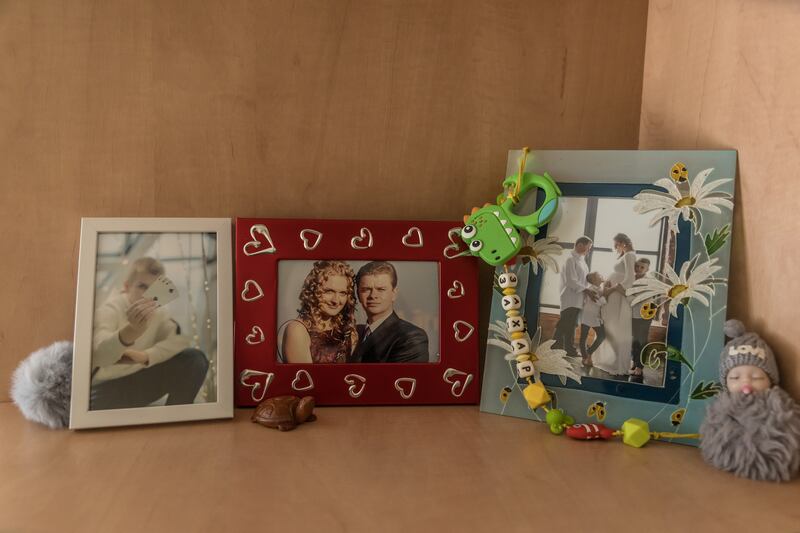
Her grandmother once lived on the eighth floor, near the top of the green-painted stairwell in a block of buildings on the eastern bank of the Dnipro river, known as Kyiv’s left bank. When a second-floor unit became available in 2019, Popova and her husband, Serhii Kushch (44) leapt at the opportunity.
Popova liked that there was a government-funded Montessori school nearby, close enough for her older boys, Artem and Tymofii, to walk to class. Even better, the downstairs unit was a health lab – no neighbour to complain about the noise of small children on their ceiling at bedtime.
On the night Russia invaded, Popova was so certain it wouldn’t happen that she didn’t bother to pack a suitcase. But around 4am, as her family slept – the boys aged one, nine and 12 – explosions ruptured the quiet. The war had arrived under the cover of darkness.
For a while, she said, she laid in bed, staring at the ceiling. “Is this it?” she thought. “Or is it not?”
Then her father-in-law called with news that Russia was shelling Boryspil International Airport. She knew they had to leave their densely-populated neighbourhood and get away from Kyiv.

Kushch filled up their car. Popova zipped clothing into suitcases, gathered their passports and emptied and unplugged the fridge, not knowing when they’d return. She remembers telling her boys to hurry. Russia was attacking them. It was the start of a war. She didn’t want to hide the truth.
They spent nine days at her husband’s parents’ home in the Kyiv Oblast before deciding to evacuate for good. Shelling had intensified, the sound of bullets from crossfire zinging through the air. So they drove west. In each of her son’s pockets, Popova stuffed a square of paper, penned with their name, age and the phone numbers of her and her husband, plus their godparents. She worried they might get separated – or worse, she and her husband killed. Writing each note brought fresh tears. She instructed them not to take off their shoes in the car in case they needed to jump out and run.
The 550km trip to Lviv, which normally takes a handful of hours, lasted days. Traffic was gridlocked. Hotels were overbooked. Popova found lodging by posting on social media, relying on the goodwill of strangers. Checkpoints choked the highways. A woman – panicked about finding medical care for her elderly mother – slammed into their car while trying to merge.
[ ‘Human safari’: In Kherson, Ukraine, to step outside is to risk death by droneOpens in new window ]
In his car seat, Zakhar sobbed.
Finally, they made it to Lviv. Near the Polish border, it was considered Ukraine’s “safe” city. A friend had offered them her two-bedroom apartment for a few weeks while she was away at her seasonal country house, or dacha. The boys were delighted to find children’s beds shaped like race cars.
Finally, they took off their shoes.
Within a few weeks, their normality again fractured. Kushch volunteered for the Territorial Defense Forces, protecting their country while Popova prepared to flee it.
She’d been offered a spot in a government programme that opened off-season hotels in Bulgaria to escaping families.
“I didn’t know where we were going: what city, what hotel,” Popova said. “My husband, left behind. Me and my three kids, into the unknown.”
She’d never been to Bulgaria but she promised Artem, Tymofii and Zakhar that they’d return to Ukraine some day – and see their father again. She had few answers and didn’t pretend to know otherwise.
“Yesterday and today are some of the hardest days,” she posted on Instagram. “There is no end.”
Their home became a cramped hotel room in a historic Bulgarian village. The older boys took the pull-out sofa, Popova shared the bed with her toddler. For weeks, Zakhar cried himself into hysterics. He missed his father and didn’t understand where they were. Popova comforted him while trying to get Artem and Timofii back on schedule with online schooling. There was no stove so she cooked food – more packaged and overprocessed than she’d like – in their microwave, supplementing it with fresh fruit and yoghurt from the grocery store.

She tried to remember to breathe, pressing a cold water bottle to her forehead to calm down and, in rare moments of solitude, crying.
“I really miss the past life, but transformation is never without pain and difficulty,” she said, returning to Instagram to try to regain her token optimism, posting another photo of nature. “All this makes us stronger and builds our spirit.”
Spring bled to summer. The war ground on.
Popova learned to weave macramé dresses. She took the boys to a water park and picked blackberries with Zakhar, now teething. She talked to friends who’d also fled Ukraine and didn’t plan to return. She tried to get back to work but struggled to maintain a schedule while single parenting and worrying about her husband. She no longer felt like the woman she’d been, assured and committed to her goals, certain of her future, prepared to answer her children’s questions.
Then, in mid-August, she and Kushch decided it was time to return to Kyiv. He met her in Bulgaria and together they brought the boys home.
Slow assault
Four years later, Popova wakes up in her old apartment, makes coffee and reads the news on her phone.
Russia continues its slow assault. More peace talks in Geneva. Ukrainian president Volodymyr Zelenskiy pushes back against demands to sacrifice land for peace, saying on X that “we are ready to speak about compromises with the United States. But not to get ultimatums from the Russians again and again”. US president Donald Trump calls the war “very unfair” to American taxpayers.
Out east, the front line has become a miles-wide kill zone, surveilled by drones that hunt anything that moves. In central Kyiv, an exhibit on anti-drone netting is erected in Khreschaty Park, with two drones snared in its webbing, illustrating how lives are being saved in these at-risk communities. People walk across the Arch of Freedom Bridge – formerly named for the friendship between Ukraine and Russia – to read the placards.

On Maidan, or Independence Square, a monument to fallen soldiers continues to grow. Icy paths are trodden through the sprawling memorial, cutting past bouquets of cloth flowers, tightly-coiled yellow and blue Ukrainian flags, and portraits. The eyes of young men – holding rifles in fields of sunflowers, proudly wearing military green, cradling a big white dog – peer from frames partially buried in the snow, their faces and memories obscured by a winter that brought more cold and cruelty than Popova could have imagined.
Glistening in a nearby pine, navy Christmas ornaments bear the call signs and ages of deceased soldiers – forever 22, 23, 26. On a recent afternoon, a woman in a long blue coat stopped, taking in the sight, then making the sign of the cross.
Popova puts down her phone. She can only read the news once or twice a day.
What to tell her boys about this war?
She reminds them that their generation will be the one to rebuild Ukraine, that they need to stay healthy, physically and psychologically. She tells them to focus on their education – a loss for millions of other Ukrainian children who have been displaced or had their schools destroyed. She promises to keep them safe, fitting a mat over their bedroom window to protect against shrapnel from nearby explosions, and sitting with her middle son when overnight attacks brought on panic attacks. She tries to make their lives normal, sending them to summer camp in the Carpathians and allowing an hour of cartoons on weekdays.

On the wall of their bedroom, she hangs typed letters from her and her husband: “Difficulties make you tough, overcome them and keep moving forward!” and “Wherever you go, whoever you become, whatever you do, I will always love you! My love is a talisman.”
But she also tells them the truth, bringing them to see their grandmother’s apartment building, struck this winter by an Iranian-designed Shahed drone. The building is still splodged with dark ash, plywood covering the rows of empty windows. She wants them to understand what this war has done to their country.
“I never thought about hiding something from them because they will figure it out anyway,” she said. “We don’t know how long this war will take. We don’t know what will happen to us.”
Four years in, what else can a mother say?
“It’s not an anniversary if they keep bombing you.”
No heating
In truth, they are different people now.
Popova’s oldest son is now 16. He has grown tall and ornery – a teenager is still a teenager, even in a war. At five, her youngest is almost as old as the conflict itself. Zakhar has no memory of quiet nights or peace. He’s made a nest of soft sheets in the top of the bunk bed that he shares with his 13-year-old brother, stickering the wooden frame with images of planets, pizza and dinosaurs. A blue dreamcatcher hangs near his pillow to snare his nightmares.
On a recent afternoon in mid-February, just a few days before the fourth anniversary of the full-scale invasion, Popova rushed around their apartment, preparing Zakhar to walk with her to work. Her husband, now a furniture salesman, wasn’t home yet. As a father of three, he was exempt from military duty and had gone back to civilian life. Zakhar bit into a biscuit, crumbs falling to the floor. Popova set down her mug of tea, now gone tepid, to help.

Outside, snowmelt tapped against the metal roof and puddled on the sidewalks. Though the official start of spring was a week away, bricks still rested on Popova’s stovetop. Russia’s repeated assault on Ukraine’s energy system – amid the coldest winter in years – had pushed it to the brink of collapse, and after living without electricity or heat for days at a time, she’d taken to heating up bricks to warm the children’s room. Her husband, meanwhile, kept their battery-powered lamps and power banks charged at a city-sponsored heating tent.

Zakhar ran into his bedroom.
“I got scared one time when I heard a bang,” Zakhar said, pointing at his bed. “When I wake up at night from the bangs, I run to the corridor or get Mum and Dad.”
It reminded her and her husband of when he’d returned to Kyiv in April to check on their home – only to find their calendar still stuck on February 2022. No stability, no plans. Calls for resilience hitting against exhaustion. Their life had intersected with the war in such a way that the war had become their life.
“I don’t think I’ve accepted it at all,” Popova said. “I didn’t want this war. But the scariest part is you get used to it.”

She helped Zakhar slip on his snow pants and Star Wars gloves, then pulled her silver parka out of the wardrobe and zipped it up to her chin. They stepped down the green-painted stairwell of her childhood and outside, into a cold, bracing wind. They turned toward her work at the nearby Montessori school. Sunlight glinted off the snow and the windows.
She had nothing else to say.
She reached for Zakhar’s hand.
Additional reporting by: Anastacia Galouchka


