Ireland’s record-breaking storming of English rugby’s citadel on Saturday has set up their concluding Six Nations home games against Wales and Scotland nicely. Win the first of those games next Friday week and at the very least that would ensure a Triple Crown shoot-out with the Scots on the final Saturday, March 14th.
The day after Ireland host Wales, Scotland are at home to France in a clash between the top two after three rounds. A Scottish win would blow the title race wide open, but if France win with a bonus point, they will retain their title in advance of setting up a tilt at the Grand Slam at home to England in the Super Saturday finale.
This follows France’s 33-8 win over Italy in Lille on Sunday, which has taken them to 15 points. A fourth bonus-point win would thus put them on 20 and as Ireland sit on nine points, the maximum they can obtain is 19.
That will not dampen the spirits of the estimated 20,000-plus Green Army which had Twickenham to themselves when the players returned to the pitch after Saturday’s 42-21 victory, their biggest away win over England.
READ MORE


Neither did the rain, which thankfully didn’t hit southwest London until a post-match downpour, judging by the bars of Richmond and elsewhere. The ex-pats had Sunday to either recover or continue their celebrations in advance of returning to work on Monday with their heads high.
Ireland may not have the best home fans in the world, but they have the best away fans and they witnessed a statement win, no doubt.
“Hopefully that puts a bit of lead in everyone’s pencil for the Welsh game and then we know how big the Scotland game is going to be with everything that is coming around the corner,” said Andy Farrell, with next year’s World Cup pool meeting in mind.
Farrell was especially pleased with his team’s “unstructured stuff” and three of Ireland’s five tries emanated from broken play or transition, the clearest sign yet that he is building a new team as opposed to re-invoking the side of 2022/23.
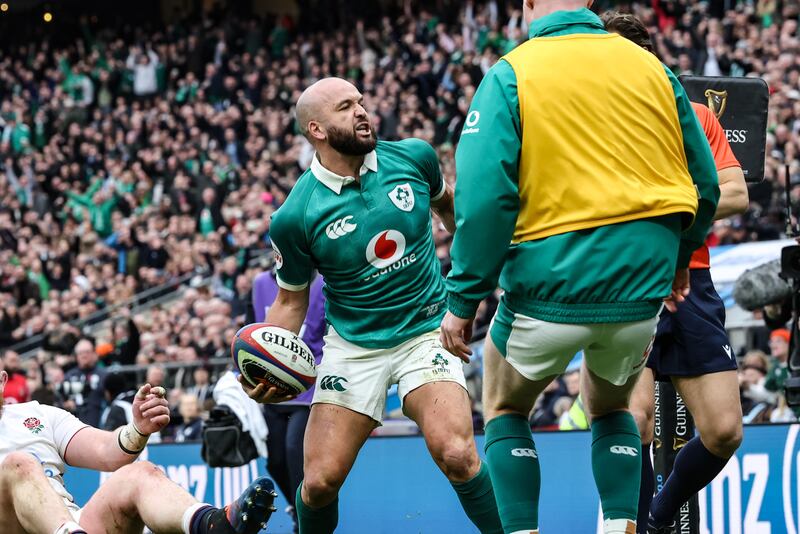
Farrell’s faith in his proven Test match animals was vindicated, and he added: “Caelan [Doris] was back to his best, Joe McCarthy was outstanding. Josh [van der Flier] was immense in that first half with his line running and stuff like that.
“We said before the game, big-game players turn up and make big team performances happen. They set great examples, but for Rob Baloucoune to come here and do that – you know you’re on for a good day when he’s got a poach, a turnover ball. Just his belief to take people on, and for Stu [McCloskey] to dominate at this type of level, it was a joy to see.”
The Irish coaches were, it seemed, more animated than normal (most likely Johnny Sexton is the cause of this), and situated in front of the Vips made for some memorable Kodak moments. Nothing evidently pleased Farrell more than McCloskey leading a posse of three players to chase down Marcus Smith in the 73rd minute with the game long won.
“Because he didn’t do that on Tuesday,” Farrell revealed, “and we highlighted it and there’s a few others did. He did it on Wednesday, and it just shows, you prepare properly and then it stands to you on a weekend. Those types of things matter more than scoring tries.”
Ireland’s vibrant heartbeat was Jamison Gibson-Park, whom Farrell agreed may have benefited from only playing the final half-hour against Italy a week previously.
“Here’s an interesting stat for you as far as all the GPS scores. I try not to get too carried away with it, but when he came on the field last week, our intensity grew by 30 per cent. The ball was quicker by 30 per cent and that’s what he does.”
Noting Gibson-Park’s running threat, Farrell added: “Once he’s that threat, everyone’s worried about that. He’s so strong in and around all that as well.
“That’s why I said I thought our broken-field play was so good. We were at our best when there was a pick-and-go and there was an offload, or when Jamison was scooting doing the short side. It’s very pleasing because that’s where we need to go.”
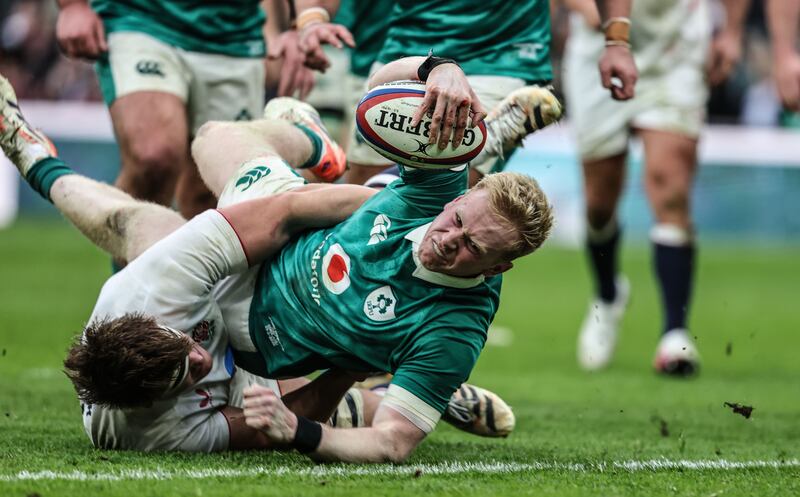
Farrell remains sanguine about the good and the bad days since the last World Cup.
“I’ve said it all along, the squad, it’s at where it’s at, and it’s always going to be at different levels to where it’s been in the past or whatever, because that’s just life, things move on. But it’s about the learnings.
“I was thinking this morning, probably the three most respected players that I know in Irish rugby, Johnny Sexton, Drico [Brian O’Driscoll] and Paulie [O’Connell], I think Drico played for 15 years and won two [Six Nations]. I think Paulie played for 14 years and won three. Johnny played for 13 years in this competition and won four.
“So have a look at all the ones that they’ve not won. It’s because the group is always transitioning and learning. And, honestly, that’s why genuinely I didn’t care whether we won or lost, whether we just grew as a group.
“Because we know what we’re trying to get to as a group. And it doesn’t always translate, because people have to feel the ups and downs of international rugby to learn and grow from it. So that’s the best part of it today.”
Hence, statement win or not, Farrell was keen to view it [through] the prism of the 18-month journey to the next World Cup.
How might Ireland pull off a Twickenham upset?
“I think the strength of any team should be stronger than any individual’s belief of what they think they can get to. That’s what a proper team is. So therefore, the potential in the squad is huge. I believe that.
“You guys can say it’s ageing, or we’re missing people and they’re injured and all that stuff. But that doesn’t matter ... as long as we’re pushing forward and doing ourselves proud.
“Therefore, over the next 18 months, I think there’s plenty of lessons that we can learn and we will do. A tough couple of games coming up, a tough summer, and all that will stand to us. We want to be at our best in 18 months’ time.”