Writing about the scrum is like diving in at the deep end and hoping that it is, indeed, the deep end. But here goes.
There has been a huge amount of debate about the scrums in Ireland’s match against Italy, particularly the one awarded to Italians with just 15 minutes left on the clock. What on earth was Tadhg Furlong doing with his backside in the air while his head was still stuck in the scrum? Quite obviously, it cannot be safe. The first, most important, thing to say is that Furlong did not put himself there. So, I’ll add my reasoning to the discussion.
First of all, tighthead prop is, by a country mile, the hardest position to play in rugby. Furlong has been magnificent for Ireland, but this incident will not have amused him. He will not want a repeat against England who, like Italy, will go after Ireland’s scrum. He will be resolutely determined that England will not dominate the set-piece. Maybe it was a slice of good fortune that it was against Italy, giving Ireland the opportunity to recalibrate before Twickenham. The scrum was not attacked by the French in Paris, perhaps leading to a feeling that all was well.
The term tighthead is apt, his head jammed in between those of the opposition loosehead and hooker. And what these guys get up to has to be resisted by the Furlongs of this world, with the assistance of the secondrow locks.
READ MORE


In the case of this match, the Irish frontrow needed to set lower. They were too high, and Furlong’s shoulders would be better off below his hips. The Italians were able to get a small amount of go-forward, and then get under Furlong, not by much but enough to exert the upward push. At the same time, the Irish secondrows’ job was to lock out the scrum ensuring that it would be solid and stable. James Ryan’s input definitely looked like it needed a lot more heft. And when Edwin Edogbo came on there was an improvement.
The penalty, and at least one more, should have gone to Ireland. There is no law against going backwards, but pushing upwards in the scrum has always been illegal. It is specifically outlawed, twice, in the scrum law. It requires players to push straight and parallel to the ground. It is also separately coded as dangerous play. Referees are all too keen to reward the scrum which has any forward momentum, no matter how slight. The officials need to revisit their approach so that the “driving up” offence is a priority.
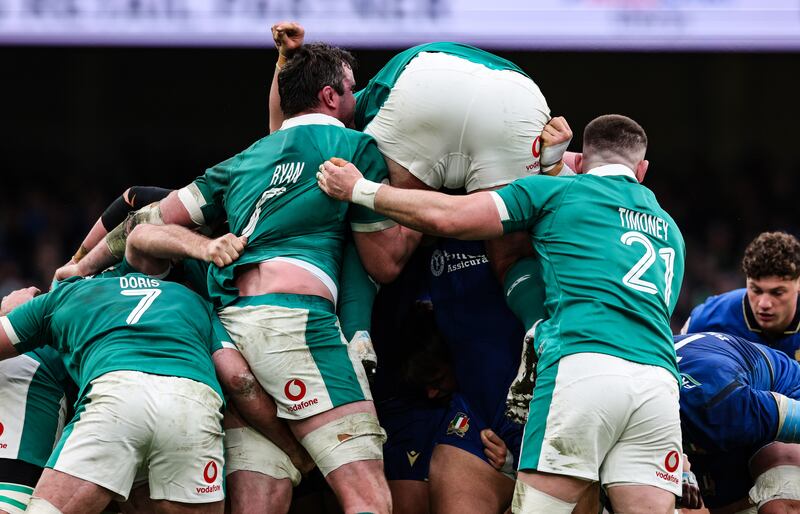
Quite some years ago, this action was becoming quite fashionable. However, referees took a tough, uncompromising line on it and whistled it out of the game. When it does happen now, that is the approach officials should be taking. Ireland will have had the opportunity during the week of reminding referee Andrea Piardi of the relevant laws. I’m sure they took it.
There is a perception that scrums are difficult to officiate, and, with so many moving parts that is undoubtedly so. However, the referees have done a huge amount of work in recent seasons, and the majority of the calls seem to me to be correct, and well explained. My pet hate, though, is to see a prop penalised for hinging when his opposite number, legs extended behind himself, has pancaked to the ground.
Where to now for the scrum. It is one of the game’s key identities and provides a huge amount of space out wide for the backs to attack. However, for a long time now it has been used far too much as a penalty-generating machine, accompanied by repetitive resets adding to the problem. It has become a blot on the landscape and one would assume that World Rugby are anxious to fix it, including the risible put-in. But that’s an assumption which, sorry to say, is far from what’s happening. Instead, World Rugby have the scrum on death row.

We’ve already seen a number of scrum decisions changed to free-kicks and there are even more on the way in Super Rugby. We will now see free-kicks for accidental offsides, and delaying playing the ball at a ruck – both are currently scrum calls. Handing uncontested possession to your opponents for an accidental offside is a total nonsense. All of this is, we are reliably told, fan-focused. Which fans I wonder?
This can’t just be a north v south issue. There are fans in both hemispheres who appreciate the value of the scrum and what it means to the game. It’s also impossible to imagine that South Africa are happy with the proposals. Moving to free-kicks in the hope that it will attract more fans is chasing fools gold.
The free-kick is as near to rugby league’s play-the-ball as you can get. Quickly taken, the player cannot be touched by any opponent who is not already back 10 metres. It’ll produce plenty of helter-skelter stuff, without any structure. It will not replace the space created by a good scrum, which ties up nine opponents in a relatively small space.
Recently, the chair of World Rugby, Australia’s Brett Robinson, insisted that union is not moving towards league. But, in reality, most of the recent law trial changes are straight out of league’s playbook. Scrapping the scrum is a very blunt instrument to employ in working towards the otherwise meritorious objective of getting more ball in play time.
That objective, however, does not justify taking the scrum out of the game. It is one of the sport’s great characteristics, and those are what makes rugby union unique. We lose that uniqueness at our peril – sure there would be some sort of game but it would not be rugby union. Unions, not in favour of these proposals, should hold firm to their position. Throwing the scrum to the wolves would represent a grave, irretrievable error.