The storm clouds lingered overhead. Mid-May and Cavan had just beaten Mayo in Castlebar. Down our way, the mood was as you might expect. But as the fallout rumbled onwards around the county, it was up to us in the dressingroom to refocus the group to face Tyrone. That was all that mattered. And then it wasn’t.
The following Saturday, just one week out from playing Tyrone in Omagh, I was out on the MacHale Park pitch ensuring everything was in place for our scheduled training session.
Kevin McStay was still with the rest of the group as they finished their warm-up on the adjacent field, but as some of the players started to make their way to the main pitch, I could hear somebody calling out for the medical team.
As I made my way towards the tunnel to see what the commotion was, I saw the physio and our S&C guy leading Kevin towards the medical room.
READ MORE


Initially we thought it might have been something as simple as he hadn’t eaten breakfast and was feeling weak or light-headed. But when the boys got in touch with the team doctor, he arranged for Kevin to attend Mayo University Hospital in Castlebar.
It’s peculiar how these things work out. We normally trained at 10 or 10.30 on Saturday mornings but plans were rejigged that day as some of us on the management team were travelling to Ballybofey afterwards to watch Donegal play Tyrone.
So, rather than have the session early in the morning and then wait around for a few hours, we adjusted the schedule so we could go straight to Ballybofey after training.
Kevin wasn’t due to travel and that is where the later timing of the session might have proved a blessing in disguise – because when he started to feel unwell it was in an environment where he was surrounded by medical personnel immediately.
Our chief concern obviously was that Kevin was okay. But at the same time, as he was going to A&E, we had to try keep the training session on track and ensure the focus remained on addressing certain issues from the Cavan match.

Cavan fully deserved their victory but for us it was just a total underperformance. We had been so lethargic.
We had beaten Cavan the previous summer by nine points. So the loss drained the belief from supporters. Few expected us to achieve anything in Omagh. The outlook around the county was gloomy – an unmistakable sense the Mayo senior footballers had run out of road in 2025.
What do you do? Do you fold or do you roll up your sleeves and fight for your championship lives? We rolled up our sleeves.
On the Friday night we had done a video session. We had been terrible in the middle third of the field, particularly on breaking ball. I remember that Saturday morning we worked a lot on breaking ball.
Afterwards we found out the doctors weren’t entirely happy with Kevin’s condition and he was to stay in overnight.
Leinster into another final, but are their fans buying into their URC run?
We continued with the plan and four of us headed for Ballybofey. We witnessed Tyrone ambushing Donegal. It was a statement win.
It was pretty clear that combining what we had spoken about on the Friday night, what we had worked on at training on Saturday morning and what we had seen in Ballybofey, the big focus from a football perspective was going to be on the middle third.
We later learned that Kevin was to be kept in hospital overnight and subsequently Sunday also. On my way to training that Monday, Kevin rang me to say he would be remaining in hospital for another night or two and he was out of contention for the weekend. He said he wanted me to manage the team.
It was a very surreal sort of moment because in my head I’d sort of left the Mayo management position behind back in 2018.
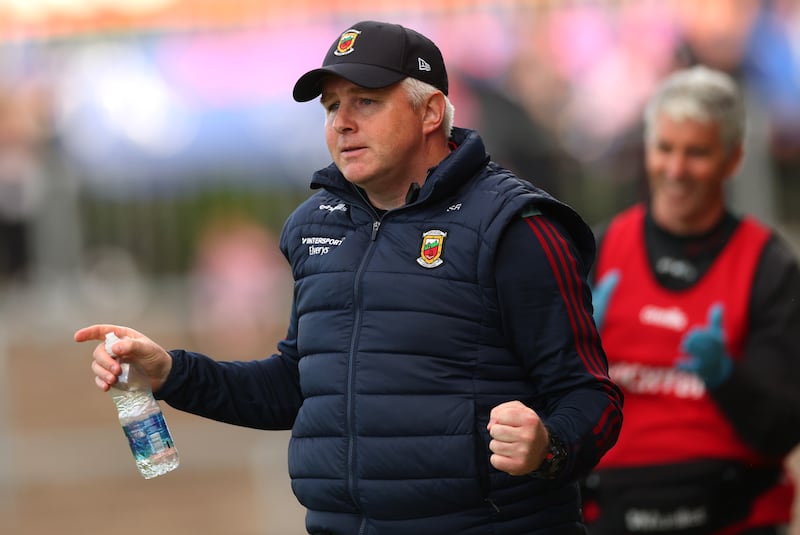
And if you were ever going to be managing the Mayo team again, you certainly didn’t expect it was going to be in these circumstances. But there was no time to reflect, so you kind of just went with it.
We spoke to the group at training. We would be looking to do ourselves proud after the Cavan performance but now also we’d try give Kevin something to feel better about.
From that moment on, the focus for the players had to be totally on Tyrone.
I decided there was no point ringing him every day with updates because that had the potential to create anxiety, but we did arrange to call him with our team selection.
It was the first time in three years that Kevin had no input in picking the team and in fairness to him he stood back completely, he didn’t look to influence or didn’t question any of the selections.
I spoke with all 26 players on the squad individually that Thursday.
Some might have been quick phone calls but I wanted to make sure players had a clear understanding of what their role was – that they understood the game plan and what the expectations were of them. That wouldn’t have been my role as assistant manager.
In some ways the underperformance against Cavan forced each individual to look at themselves in the mirror and realise it hadn’t been good enough. They wanted the opportunity to put that right.
So we constructed a detailed plan on how we’d go after Tyrone.
One area was the key match-ups on the likes of Darren McCurry, Darragh Canavan and Mark Bradley.

We also wanted to outwork Tyrone. Ever since Tyrone’s emergence as All-Ireland contenders in the early noughties, they always had this strong ability to run teams – whether it be Davy Harte, Philip Jordan or Kieran McGeary. Seanie O’Donnell and Rory Brennan had been continuing that tradition by running from deep.
We weren’t going to be reacting to their runs, we were going to be proactive – rather than be a half yard behind, we were going to be a yard in front.
And then the third issue was kick-outs, we were going to be absolutely ravenous on the breaking ball.
We looked in great detail at Niall Morgan’s restarts from the Donegal game and their four matches prior to that. We could clearly see a trend in where Tyrone were winning possession.
Significantly, though, it wasn’t necessarily clean ball. In fact they only won a single fetch against Donegal. Where they truly excelled was on hoovering up breaking ball. Out of 14 long kick-outs, Tyrone collected 86 per cent of them from breaks. Winning the ball on the ground – that was where the game would be won or lost. That was the war zone.
So we were able to position our players in that area Tyrone had been using as a platform for success. We won the breaking ball battle that day. And the game.
Tactical elements are really about creating belief and confidence in a group, it’s not about trying to be the smartest person in the room. If you start winning a couple of early kick-outs, if your players are positioned in the area where breaking ball drops, all of that contributes to creating an infectious energy and belief the plan is working.
I spoke with Kevin that evening, he had watched the game at home and it was great to hear the enjoyment he was able to take from the win at the end of what had been a very difficult week.
The challenges of those few days came back to me last week when Mayo were again drawn to face Tyrone in Omagh. There is a huge prize up for grabs this weekend with the winner progressing to an All-Ireland quarter-final.
And while so much has changed since our trip to Omagh last May, the parallel remains that the pivotal battleground is still the middle third. Whichever team comes out on top there will most likely take the direct route to Croke Park.