
Hurling had the weekend all to itself, which appeared to guarantee an ambient mood of grumbling. The game has been a little under pressure recently. Last year, enhancements by the Football Review Committee made the big-ball game a lot more watchable. A number of initiatives also shone light on issues for which football could no longer be exclusively blamed.
Discipline was the obvious one and as a result, football is now the more disciplined, better-behaved game.
The reflex response to any suggestion of importing football ideas into hurling has generally been that the latter did not have the same problems with cynical play, gamesmanship and such matters.
At the same time, there was an underlying resentment in some quarters at the entire concept of rules, especially the ones concerning foul play – short of the aggrieved team producing a death certificate.
READ MORE


Rules are derided and their enforcement protested, but, as queried in Monday’s pages by Denis Walsh, what rules don’t you want enforced and is that to be a blanket prohibition, including when you are the disadvantaged?
In Robert Bolt’s A Man for All Seasons, English martyr Thomas More – for these purposes, Tomás Mór – asked his impetuous son-in-law, Will Roper, would he “cut a great road through the law to get after the Devil?”.
- “Yes, I’d cut down every law in England to do that!”
- “Oh? And when the last law was down, and the Devil turned ‘round on you, where would you hide?”
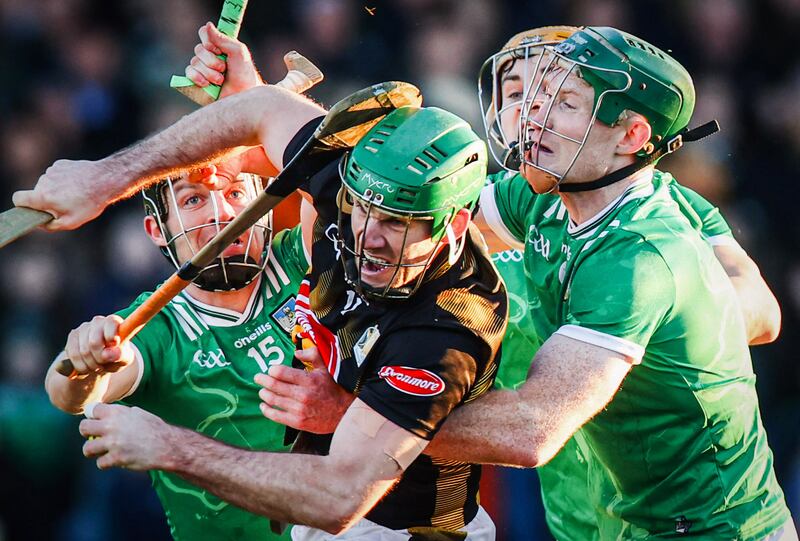
Once rules exist, there is no alternative but to apply them as consistently as possible. They are in place to protect players – from both violence and the impermissible curtailing of their skills. If the various measures are deemed unsatisfactory, lobby for change. But as long as they are in the rulebook, they have to be observed.
It makes no sense to look for a blind eye to be turned to your own infractions, but then to expect the letter of the law when inconvenienced yourself.
A range of issues were in play at the weekend. The newly in-demand black card drew the usual furore but it is simply an added deterrent to foul play or, simply put, the unfair prevention of players from utilising their skills.
Football requires intent, in order to satisfy the designation “cynical”. At present, hurling does not.
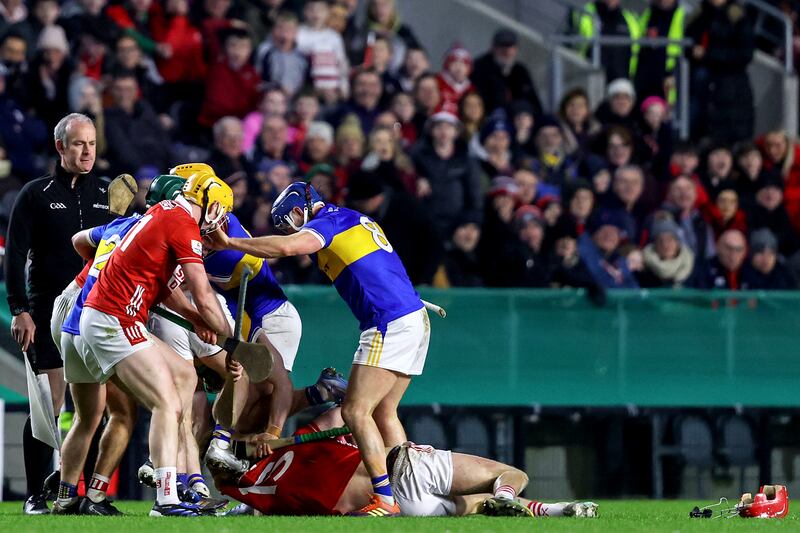
In Cork, referee Liam Gordon dismissed Shane Barrett and Jason Forde for “contributing to a melee”, which they were doing even if not alone in their actions. This rule was introduced to discourage the old-fashioned scatter. It may not always work and it may not always be equitable but overall, for the good of the game, it is considered preferable to inaction – just as the breathalyser road block north of a town may be strictly unfair on those stopped, while others make their way south unhindered.
Random maybe, but no defence for those apprehended. In football, the punishment for this infraction is sin binning for 10 minutes. Again, like the black card, it’s up to counties to decide if they want to align the rules.
The handpass was also in the spotlight. Its advocates passionately believe in it as a contributor to a better game, but it remains defined by rule. Referees are protected in enforcement by the requirement that to be in order, the ball has to be “released and struck with a definite striking action of a hand”.
As with everything else, this is a matter for official discretion. Although more rigorously enforced in this year’s league to date, the heat generated hasn’t cooled. Those unhappy with the practicality of the rule, like Conor O’Donovan – whose tireless campaigning may well have led to the current attempts at limitation – remain unconvinced.
Those who essentially believe a few throws here and there can be overlooked for the greater good are triggered by any interventions on the issue.
Nonetheless, it’s never a good idea for a sport to have rules they fail to enforce and the breach of which goes unchecked.
Ben O’Connor’s fulminations were originally prompted by a question concerning the return of the maor foirne, the team runner previously allowed to enter the pitch and communicate managerial directions. The facility was withdrawn, without dissent, in 2021 – albeit during that year’s ‘virtual’ congress at which just two motions were debated.
There are also strong views on this, expressed by O’Connor and his Offaly counterpart Johnny Kelly concerning the difficulty of getting messages onto the field to players.
The whole purpose of prohibiting incursions from the sideline was to tidy up the presentation of the game. Part of the reasoning was that managements have the entire week on the training ground plus pre-match congregation, followed by half-time in the dressingroom to make all of the points they need to.

There are also five replacements, who are nearly always deployed, mostly in the second half, and who can be entrusted with communicating whatever tactical adjustments are considered necessary.
Tactical acumen on the line is generally associated with making substitutions at the appropriate time and with what remedial action is taken at the break.
Allowing endless intervention during play is unsightly and an unnecessary extension of managerial control. Players are prepared more thoroughly than ever before in Gaelic games. Should they not be permitted to get on with it for 35 minutes without emissaries from the line suddenly appearing in their midst to move them around like chess pieces?
So far, it has all been February talk, which is unsurprising as acceptable outcomes in the league are placed on a spectrum, making it regularly feasible for both teams to go home happy.
That mellow state of affairs won’t be lasting too much longer.