
They all know it, of course. Car designers. Vehicle engineers. Company chief executives. They all know that designing a car as an SUV renders it instantly and irrevocably inefficient.
Tall springs, a chunky body, and the weight of extra driven wheels are just going to be thirstier – either for liquid fuel or the electrons stored in lithium-ions – than a car without those attributes. It’s why emissions from private transport continue to rise.
According to research by the International Council on Clean Transport (ICCT), because of the inherent wastefulness of SUVs, emissions continue to climb. Take away SUVs, and they’d be falling.
They all know it, yet paralysis seemingly abides. Car buyers’ desires, whether that be in Fermoy, Frankfurt or Philadelphia, are pointed firmly at cars that make you feel bigger, more rugged, more invincible. It’s the snake oil that lubricates the SUV’s unstoppable success.
READ MORE


Thankfully, not all cars have to be SUVs and – equally thankfully – even though it is now avowedly an SUV-heavy company (from the small EX30 to the hulking EX90), Volvo makes at least one new model that’s still, just about, a saloon.
I say “just about” because the first thing you notice about this electric ES90 – aside from the distinctly pinkish hue of the Aurora Silver paint of our test car – is that there’s an awful lot of air under the bodywork. This ES90 isn’t quite a raised-up saloon in the manner of the short-lived and little-loved S60 Cross Country (remember that? No, you probably don’t), but it definitely looks as if it’s wearing its 20-inch alloys at the end of tiptoes.
Why? Maybe so that car buyers are lightly fooled into thinking that this ES90 is an SUV after all. Maybe to provide some protection for the big 88kWh battery pack that’s underneath the cabin. Maybe because, in Sweden, the snow lies deep on the roads at times.
Whatever, thankfully the ES90 is definitely not an SUV, but it’s also not quite a saloon.

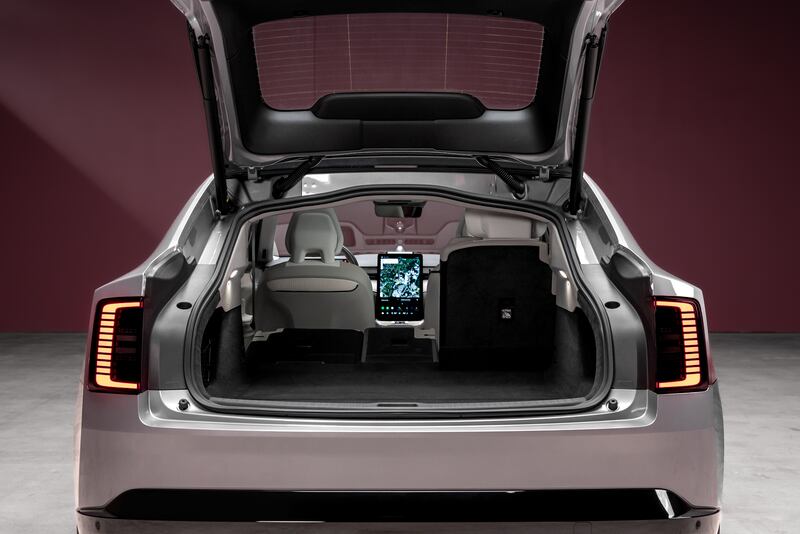
That rear bodywork actually incorporates a large hatchback, making it a halfway house between two traditional Volvo models – saloon and estate. Grab one while you can, as it looks as if proper estates are not really on Volvo’s radar, at least for the next mile of new models. Shame.
The ES90’s style is clearly influenced by the taller, seven-seat EX90 SUV – all blunt face, pixel-shaped lights and clean surfacing. I think you’d be hard-pressed to call it truly handsome in the manner of the old S90 saloon (especially with that taxi-style lump above the windscreen, which was originally meant to house a LIDAR scanner for automated driving, but which for the moment doesn’t, thanks to supply issues) but it cuts a reasonably swish dash. It’s less hard-edged than its primary rival, the BMW i5, but it’s also more characterful than the too-smooth Mercedes EQE.
[ Surge in new EVs licensed in JanuaryOpens in new window ]
Inside, you’d be hard-pressed not to fall instantly in love with this Volvo. Okay, so our test car was a highly specified “Ultra” model, so it should be impressive, but Volvo really has mastered the art of cabin design for the modern EV.

The style is minimalist, in the Scandi tradition, but it’s also warm and welcoming thanks to gloriously comfortable seats swathed in butter-soft Nordico leather. The big screen in the centre – 14.5 inches across – looks smart, as does the neat driver’s instrument display strip. Quality levels are sky-high, and there are plenty of storage spaces, although the tray under and behind the screen is too slippery in its surfacing to be much use.
Anyone slipping into the back of the ES90 might start to feel as if they’re getting the better part of the deal. Legroom is luxuriant, as is the comfort of the (heated and ventilated in this Ultra version) seats.

There’s a huge armrest between the seats, which flips back up to reveal a narrow and not very useful third seat, but your driver won’t thank you as its headrest cuts off almost all the visibility through the tiny rear window.
The boot isn’t very big – 424 litres, expanding to 904 litres if you fold those back seats – but at least there’s a modicum more under the bonnet, where the small “frunk” is just big enough for you to stash a charging cable.
At this point, I have some notes ... Volvo’s new touchscreen and its Google-based software are impressively slick to use, but the drive for a button-free interior (there is only a volume roller and skip-track buttons, plus some cabin lighting controls in the roof) has reached an unpleasant apogee here.
I know – customer clinics are telling car makers that people want more touchscreen functionality, but surely putting controls for headlights, fog lights and even door mirrors not only on the touchscreen, but more than one click away, just flies in the face of Volvo’s incredible safety legacy?
Out on the road, that touchscreen proves as distracting as any to use (often chiding you with a warning beep from the driver distraction monitor – well, maybe just don’t give us the big screen in the first place, eh?) but that aside, driving the ES90 is a close, pleasurable experience.

Well, mostly ... What it isn’t is sporty. Don’t bother adjusting the adaptive suspension or the steering to their sportier “Firm” settings – it doesn’t make much of a difference, and the firmness only highlights the occasional clunkiness of those big alloys when the wheels find a bump they just can’t quite deal with.
The rest of the time, the ES90 is serene, gliding along in blissful silence and exceptional comfort. As a way of wafting you from place to place, it’s actually pretty hard to beat.
Except in terms of its range. Volvo boasts a 650km one-charge range for this, the Single Motor Extended Range version, with its 333hp and entirely adequate performance – you don’t really need the extra thrust of the twin-motor models – and that would be impressive, but I just wasn’t able to get anywhere near that number.
[ Volvo’s new EX60 sets latest EV range benchmark of ‘up to 810km on one charge’Opens in new window ]
The best I could achieve was 450km, and while that does come with the caveat that (a) I spent most of that time on energy-sapping motorway runs, and (b) I can’t charge at home, which means I can’t pre-warm the cabin on cold, wet days, which further adds to my culpability for the inefficiency, it’s also less than hugely impressive.
True, the BMW i5 doesn’t fare much better in real-world driving, but the Merc EQE will put at least 500km between charges, and that’s on almost entirely motorway mileage.
Which is a shame, as the ES90 is such an otherwise likable car and, to be fair, I never once felt like I wasn’t going to be able to complete a journey – I was just topping up the battery a bit more often than I would have liked. Would it hold you back from buying one? Or did you tune out ages ago, when you realised that this is not another SUV?
Lowdown: Volvo ES90 Single Motor Extended Range Ultra
Power: 245kW e-motor developing 333hp and 480Nm of torque, powering the rear wheels via a single-speed automatic transmission.
CO2 emissions (annual motor tax): 0g/km (€120).
Electric consumption: 16.5 kWh/100km (WLTP).
Electric range: 650km (WLTP); 450km (Observed)
0-100km/h: 6.6 sec.
Price: €100,295 as tested; ES90 starts from €79,995.
Verdict: One of the best automotive cabins around, and super-refined too, but the ES90 could do with more real-world range.


