

The Government may have paused a review of the allocation of special needs assistants (SNAs) in schools but concern remains among parents of children using their support.
Parents fear a change in how needs are defined or a reduction in SNA numbers at individual schools could impact the level of support their children receive.
Louise Lennox’s 12-year-old son Alex avails of SNA support at school. He has dyslexia, dysgraphia, attention deficit hyperactivity disorder (ADHD) and is awaiting an autism assessment.
His mother believes any move to reduce SNA numbers in schools will affect “every single person’s child that is in a school”.
READ MORE


“Children like my son won’t get a movement break, so there’s going to be more challenges for the teacher in an oversized class,” she says.
Movement breaks are designed to create stress relief or mood enhancement through physical activity and to avoid long periods sitting at a desk.
Lennox says if her son does not receive movement breaks she will feel the consequences after school.
“When he comes home, he falls apart,” she says, adding it can also affect his eating.
“He needs that movement ... And if he doesn’t get that – he finds learning really challenging as it is – we can forget about his educational needs.”
The movement breaks also give Alex a chance to connect with other neurodiverse children, she says, as he usually spends lunch breaks on his own. “He finds communication and friendships really challenging.”
Lennox says SNAs are “not an addition to a school, a nice-to-have; they help children cope with being in school”.
Aisling Owens Nash’s 11-year-old son is connected to the autism class in his primary school. She is hoping he can fully transition to mainstream classes but, if his access to adequate SNA support was to change, these plans would be disrupted. “We would probably strongly consider keeping him in the unit. And it’s not what we want.”

Owens Nash’s goal “is to mainstream him with support. Because he’s never not going to need some level of support.” He needs SNA support “to navigate the social aspects, but also his own emotional regulation, and watching for the signs in him that he needs to take a break – so that they can help him to recognise that and take that break and not feel bad about it”, she explains.
Her nine-year-old daughter has also just started to receive SNA supports, “mostly movement breaks in peer groups”, following psychologist and occupational therapist reports. She is finding them very helpful, and Owens Nash worries her daughter will lose access to this if SNA numbers are reduced.
Author, comedian and mental health advocate Rory O’Connor is worried about what it would mean for his seven-year-old son Zach if he was to lose access to his SNA. “He’s in first class, and he’s struggling. He’s struggling to read and write, and [with] retaining information.” O’Connor has seen his son’s anxiety and emotional dysregulation increase recently as a result.
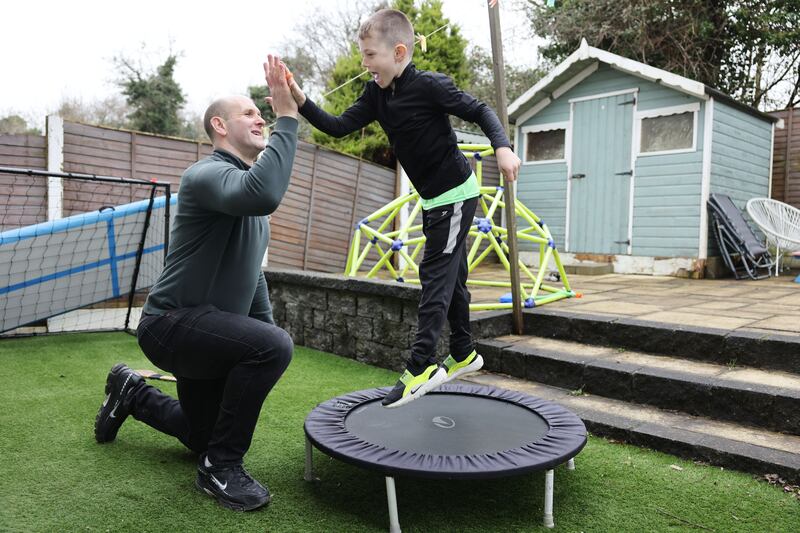
Zach has dyslexia, ADHD and is autistic. O’Connor has dyslexia and ADHD himself. He knows first-hand how difficult school can be for children with learning differences. He is very conscious of the long-term impacts and social consequences that this can lead to, if a child is not properly supported.
“I was one of them, misunderstood in school, a bit of a messer, ended up getting nothing out of primary school, kicked out of class, and facing the wall. I know myself the impact it had on me. Like a lot of my generation, you can stand over my dead body if you think it’s going to happen to my child as well. There is nothing worse than a child feeling inadequate or stupid when they’re not. The SNAs are vital cogs in keeping children confident and chirpy in school.”
Sandra Owens has been an SNA since 1997 and is a member of Fórsa. Her school, St Andrew’s in Lucan, was notified it was losing 5.83 posts, “five full-time posts and one junior infant day, so six people, basically”, she explains.
“We need to change the contract – that it doesn’t just limit us to care needs,” Owens says. Looking at the school’s needs versus its SNA allocation, Owens questions how staff will be able to work next year.
“There’s going to be enormous pressure on the classroom teachers and particularly the SET [special education] teachers. Children that we help are going to be left now, because obviously we’re only going to be able to help [with] the major problems.”

Owens says “we’re going backwards in education terms”. With teachers unable to fully focus on teaching “it will 100 per cent affect the whole school community”.
Staff at St Andrew’s plan to stand outside the school from Monday in a show of support. “We’d be better off with them taking those school dinners back and giving us the budget for ourselves if their cuts are financial ones,” Owens adds.


