Storm Chandra brought extensive flooding last month in south Dublin along the rail line serving Ireland’s east coast, causing disruption for thousands of commuters. However, residents in Blackrock and neighbouring areas have mixed opinions about a proposed solution from Irish Rail to defend against future floods.
Irish Rail is seeking to build concrete walls on top of the existing stone walls on a 4km stretch from Merrion Gates to Seapoint. It says the works – which would add 1.3m to the height on average – are vital to protect the rail line from rising sea levels.
But not everyone is convinced.
“I think it’s a solution that’s going to save maybe one day and then 364 days a year we’re going to have a huge concrete wall blocking us off from the sea,” said Kate Ruddock (40s) who has lived in Blackrock for eight years.
READ MORE


She said she had never seen “anything as bad” as the weather the area had experienced last month.
The waves that caused the tracks to flood are “a rare enough situation”, she said. “It only happens when it’s on the spring tide at high tide and the easterly [wind] is blowing.”
“The climate is changing. Those storms are becoming more intense. Maybe it’ll happen once a year. I don’t know exactly. But I do know a 2m-high wall wouldn’t have done anything in that storm.”
Ruddock and her family use the Dart frequently for commuting to work in the city centre or going to school. However, she said, the plan needed “more thought” and would “ruin the coastline”.

In contrast, Susie O’Mara (40s), from Mount Merrion, is supportive of the plan. “I have a major problem with the lack of investment along the coastal areas of Dublin.”
She said her son used the Dart daily when attending school, adding the delays and closure of the line previously was “really disruptive” and “insane”.
[ Why are flood defences taking so long to build? Don’t blame the pearl musselOpens in new window ]
“I don’t see why anyone wouldn’t want those walls built, to be honest,” she said.
Erin Shrimpton (40s) from Glasthule also supports the plan. “I think anything that invests in our infrastructure is clearly needed here. We have a global workforce coming to live here and clearly don’t have the infrastructure to facilitate people.
“We have a beautiful coastline. It’s amazing, we have to protect it,” said the psychologist.
The 4km stretch of line is one of five sections of track prioritised for works under the East Coast Railway Infrastructure Protection Projects (ECRIPP) scheme.
Labour councillor Martha Fanning described the scheme as “absolutely essential. It’s just how we do it”.
She is concerned that Irish Rail is not considering the “public realm and public experience”, describing the wall as “a fairly brutalist design”.
However, Fanning said: “We have commuters in crises ... so we absolutely have to protect the train lines. It’s just about maintaining and enhancing our access to the beach and the sea.”
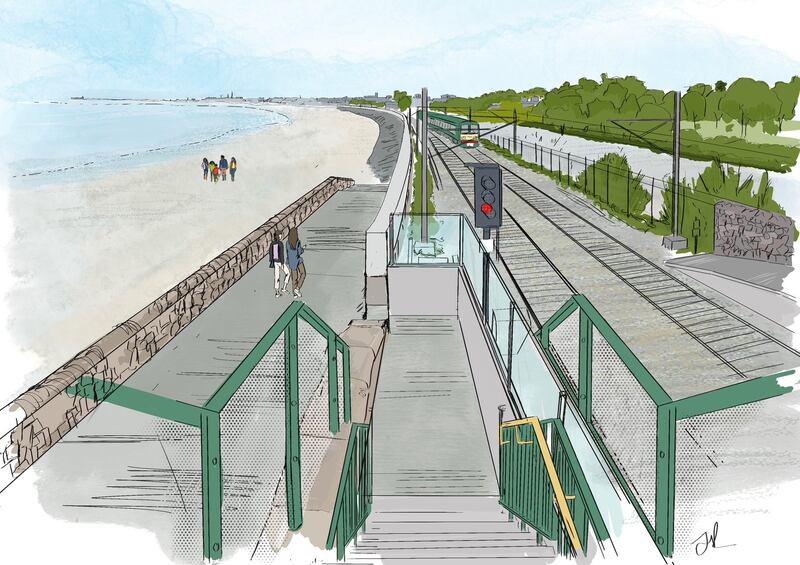

Fine Gael councillor Marie Baker said she was concerned the project may cause “other environmental issues” and mask the “scenery of Dublin Bay by a wall that may not actually do what it’s meant to do, which is protect the line”.
She said: “The Dart line is an important piece of infrastructure that we need to maintain. It’s how we all go about that, is the important thing.
“The power of the sea can be ferocious ... I don’t know what kind of a structure you could build in truth to keep it back.”
Green Party councillor Conor Dowling described the proposed construction as a “short term” solution.
“At the moment, just throwing up a big old wall and blocking people from the area is not good enough. So while, obviously, you need flood defences, I don’t think there’s joined up thinking.
“We need to properly explore nature-based and landscape-led solutions that reduce wave impact while keeping the coastline as open as possible, accessible and recognisable,” Dowling said.
Similarly, retired architect Michael Collins said Irish Rail’s approach to the protection of the railway is “inadequate”.
He said photographs from the recent storm showed waves overtopping the current seawall by about “four to five metres”.
The proposal to raise the walls by about 1.3m will in “absolutely no way ... prevent what happened earlier”, he said.
[ ‘Don’t panic’: Ireland’s sodden golf courses hope to bounce backOpens in new window ]
The waves could be up to 50 tonnes, Collins said. “When they hit a vertical piece of wall ... the wave goes straight up into the air by the four to five metres.”
A spokeswoman for the National Transport Authority (NTA) said, since 2021 Irish Rail and NTA have invested in the protection of the Dublin-to-Rosslare rail line against the threat of coastal hazards and since 2022, have progressed plans to provide long-term, improved coastal protection to this line under ECRIPP.
“ECRIPP was established to deliver the necessary enhanced coastal protection to existing railway infrastructure between Dublin city centre and Wicklow.”
She said “all relevant stakeholders, including the general public, have been invited to provide feedback” throughout the design development.
ECRIPP has undergone two rounds of public consultation in 2025 “and the feedback received has been used to refine the preferred option in advance of preparing the statutory planning application”.
It is “anticipated that planning submissions will be made in late 2026 following approval of the preliminary business case”.


