
Fifty years ago, when Ireland’s first atlas of mammals was published by An Foras Forbhatha, deer were not particularly common on the island. The unique red deer of Killarney were, as they still are, confined to the area in and around the national park but nearly went extinct after the famine of the 1840s.
Herds of red deer from Scotland or mainland Europe were subsequently imported in the late 19th and early 20th centuries. Sika deer from east Asia were introduced in Co Wicklow in 1860 while fallow deer from across Europe are suspected to have been brought in by the Normans 1,000 years ago. There remain sporadic reports of two other species, the tiny Asian muntjac and the European roe deer, although neither are believed to be established.
Legal protection under the 1979 Wildlife Act brought licensing requirements for hunting, while maturing forestry combined with a lack of natural predators allowed deer numbers to grow.
By the early 2000s people began speaking about the deer population in problematic terms. In 2011, the first peer-reviewed study on the changes to deer distribution in Ireland, led by Ruth Carden at the National Museum of Ireland, was published. The study noted that there had been a “considerable expansion” in all deer species between 1978 and 2008 and that “deer are already impacting on both the economic and biodiversity values of habitats in Ireland”.
READ MORE



In 2015, a cross-departmental group published Deer Management in Ireland – a Framework for Action. While the report identified some of the policy barriers to effective deer management, it did not deliver a co-ordinated approach to reducing deer numbers.
Lockdowns during the Covid-19 pandemic effectively stopped hunting, allowing the deer an unprecedented respite, which likely boosted numbers considerably.
In 2022, a Deer Strategy Management Group was formed to co-ordinate the work of various State agencies. It led to changes to the open season while two species, the fallow deer and Sika deer, were designated alien invasive species.
In 2023, Farm Relief Services, a private contractor, was appointed to deliver a number of actions in the strategy including running 15 “deer management units” to better co-ordinate hunting activities.
There has never been a deer census in Ireland and so numbers, or the changes in numbers, are unknown. Nevertheless, discussion has generally moved on from numbers to impacts; why waste time and money counting deer when the impacts are plain to see?
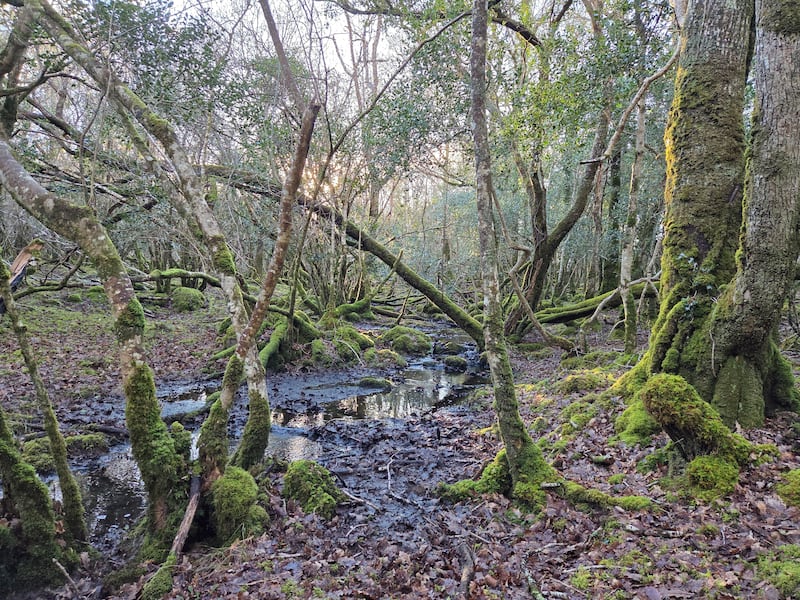
On a visit earlier this year to a “special area of conservation” in Galway, supposedly protected for its remnant ancient oak woodland, these impacts were obvious. The site is a rare surviving example of Atlantic rainforest but its future is daily imperilled by high deer numbers. Instead of a thriving layer of ground flora, shrubs and young trees, everything below the height of a deer’s mouth has been stripped away. The ground has been churned to mud. While the mature canopy remains intact, this too is under threat as hungry deer will strip away bark and this can kill the trees.
To the ecologist, the impacts do not stop at preventing regeneration of trees in native forests. Deer preferentially eat broadleaved flowering plants, leaving meadows with only grass and nothing for pollinating insects. This can be seen in Dublin’s Phoenix Park, where vast areas have neither flowers or insects even at the height of summer.
In stripping out the shrubs, nesting habitats for songbirds are removed. This was recently demonstrated in research from University College Dublin that found lower levels of bird activity in areas of high deer density, stating that “high levels of deer disturbance can reshape avian community composition”.
Deer, particularly red deer, which is believed to be native to Ireland and to have been present here for thousands of years, are a natural and important part of Irish ecosystems.
However, the high numbers today are a symptom of general ecosystem dysfunction. This was highlighted at the Oireachtas agriculture committee last May when Teddy Cashman, chairman of the Deer Management Strategy Group, told the members: “The biggest problem we have with deer is that they have no natural predator in this country.” Nevertheless there is, as yet, no serious discussion about doing anything to address this.
Adam F Smith is a wildlife ecologist and researcher with University College Dublin. His doctoral thesis looked at interactions between predators, prey and people in Europe. In parts of the Continent where there are still large tracts of intact habitat, he says “things tend to regulate themselves” but “that’s not the case in most of Europe”.
Adding wolves to landscapes is not the magic solution it is sometimes portrayed as, but they have an important role to play.
“Humans and large carnivores can work together really well because we hunt in a certain way, generally dawn and dusk and a little bit during the day,” Smith says.
“We can be much more selective in the animals we take and we can hunt in places where wolves can’t be, such as city parks. What wolves and lynx [both once present in Ireland] do is apply pressure in a different way. Hunters are not out 24/7 but a wolf is always there, it doesn’t go home.
“What that means is that you have a constant pressure, especially at night-time or in places that people find difficult to reach and hunt effectively in, and what you get is prey that is squeezed between these dual-risk landscapes.
“Where those two risks are present, deer will not stick around to eat every sapling or bark-strip every tree”.
Smith describes the current deer management strategy as a “marathon not a sprint” and an “attempt to put structures in place for hunters and landowners” but lacking what he describes as an “ecological component”.
[ The company of wolves: should large predators be reintroduced to Ireland?Opens in new window ]
The approach taken is not to target specific areas or specific habitats or specific problems, he says. “It’s more: if you have a problem we’re here to help you solve it.”
This has caused some confusion as the problem with high deer numbers varies depending on who you talk to. The Road Safety Authority says there were 1,300 road traffic incidents involving deer between 2019 and 2025. For farmers the issue might be damage to fences, eating grass meant for cattle or the perception that deer will spread bovine TB.
TB is a serious disease that is predominantly transmitted between cattle but wildlife often ends up saddled with the blame.
Nevertheless, when the public consultation was carried out in 2022, 82 per cent of respondents said that biodiversity loss and damage was very important or somewhat important.
The Deer Management Strategy does not increase the level of hunting currently under way. Rather it attempts to co-ordinate it better. This is useful but Smith says there remains a need to increase overall hunting pressure.
He talks about the need to foster a greater culture of hunting, something he says we had, but which was interrupted by colonial rule. We need to make it easier for people to become hunters but access to land is a bottleneck – hunters can only hunt on land where they have been given permission.
He notes the conflict between the need to lower deer densities and the incentive to keep densities high through the profit-driven sale of hunting concessions, including by Coillte, the State forester and largest landowner in the country.
Smith says Coillte should be designing their forestry operations with deer management in mind, noting that most European countries create hunting spaces within plantations, install high seats where hunters can sit at a height overlooking a clearing, or lanes to allow hunters easily extract a carcass. A bounty on woman deer, currently under discussion, would also help.
Even if the current efforts are successful in developing an approach that addresses deer impacts, the issue will remain with us in perpetuity. There remains a need, therefore, for cost-effective and sustainable solutions. In other words, a long-term strategy must include a place for predator reintroduction. Continuing to ignore basic facts of ecology should not be an option.


