
“Climb aboard and see what your library has to offer!” is the jaunty invitation on the side of the mobile library parked in a council yard just outside Dunmanway in Co Cork. It is a Monday morning, and bus driver Seán Crowley and librarian Zillah Ní Loideoin are getting ready for work.
Work today is driving a route out the Beara Peninsula, stopping at various locations along the way to serve different elements of the community. There are 27 mobile libraries around the country, all operated by various county councils. Co Cork has four of them, and they all go on different routes on different days of the week. Our free library network is one of Ireland’s greatest public services, and today I’m going along with Crowley and Ní Loideoin to see how a mobile library works.
“It’s the size of a standard bus,” Crowley says, as I walk around it. He has been driving this bus for 16 years. Ní Loideoin has been working in the service 20 years. There’s a two-person cab up front, and in the main part of the bus, there’s a set of central doors with expanding steps, and a facility for wheelchair access. Crowley can open the doors from the cab. Within the bus itself, there is a surprisingly large space, with a stock of some 3,250 books. Of those, 1,000 are for adults, with 2,000 for children and 200 for young adults.
“We go out five days a week and do a different route every day,” Ní Loideoin explains. They have a fortnightly schedule, so of their 10 routes, they visit each one every fortnight. As the bus only seats two, I am to take turns between travelling in it and in Ní Loideoin’s car, following behind.
READ MORE


It’s raining as we start the trip; determined sheets coming at us sideways. Even so, the rain can’t mask the staggering beauty of the landscape we travel through. We take in green hedgerows, the slumbering swathes of died-back brown and orange heather, lichen-covered rocks, fields and mountains and gushing rivulets of water, and sheep marked in blue and orange and pink, with tiny lambs still a fuzz of pure white.
To my amazement, the first stop of the day is not far from Ballylickey, at a private home. Anyone can request a stop on the mobile library route. It’s less common these days, but it does still happen, and is still accommodated. “When I started, there were more house stops,” Ní Loideoin says. When we are outside the house gates, she phones the borrower there, Hilary Finnegan, to let her know we have arrived.
Out comes Finnegan (90), holding a pile of three books, two of them romance novels. She is delighted to see Crowley and Ní Loideoin, and clambers aboard unaided to choose her next fortnight’s lot of books. Acknowledging the relentless February rain across Ireland, she has brought an old black-and-white photograph with her to show them. It’s dated 1967, and shows a woman driving a tractor through a flooded country road. “That’s me,” she says.
“We’ll all need tractors to get around if this continues,” Ní Loideoin says, and they have the chats while Finnegan takes her time to choose new books. She takes out Peter Kay’s Diaries, and The Dog Sitter Detective Plays Dead, by Antony Johnston, a “cosy crime” novel. Ní Loideoin stands discreetly nearby in case Finnegan needs a hand down the steps, or the gate opened. I am witnessing both a public service and a deeply personal one in action simultaneously. The bus driver waits until she gets inside the house, and then we are off again.
Today, most of the other stops are going to be at primary schools. We drive through Glengarriff and Castletownbere until we get to Cahermore. The school has an incredible view overlooking the ocean, from a site that any hotel would envy. Not that the Cahermore pupils are taking any notice of the view just then. There are 55 pupils here, and the three younger classes are first to race down the pathway to swap their books. Children are allowed to borrow two books, and adults up to 12.


For a few minutes, it is all a blur. Library cards are held permanently behind the counter for safekeeping, so Crowley and Ní Loideoin get the relevant cards out for each child. Books are first returned to a box on the counter, and then the children swoop to the shelves, hunting for titles with a speed and focus I barely register. My own instinct among books – even as a child – has been browsing at leisure. This is a different approach, but I swiftly learn efficiency is everything when you’re competing in real time with your classmates for possibly similar books. Also, mobile library time is time from class, as Ní Loideoin reminds me, so lengthy browsing is not realistic.
In any case, the second cohort of children arrive before I have barely had time to take out my notebook to ask questions of the first cohort.
This is what I glean from the students of Cahermore Primary School. They especially love the Babysitters series, authors Judy Curtain, David Walliams (who was recently dropped by his long-time publisher HarperCollins following an investigation into allegations he “harassed” young women), Harriet Munster, and Dav Pilkey, author of the Dog Man books.
Padraig O’Sullivan is the school principal. He arrives down to return a box of books of a Tom Crean biography, which they chose recently as a class read, where everyone read the same book. “We have a library in the school, but the avid readers will always exhaust our own library,” he says. “The mobile library gives them access to a wider range of books. It’s extra inspiration on a fortnightly basis. Also, books are quite expensive if you want recent titles, but they can access them here for free.”
[ Some disabled people are going to libraries to stay warm, protest hearsOpens in new window ]
There cannot be many jobs in the country that require two people to drive around rural Ireland every day together for months on end. (In the summer, when the schools are off, they are deployed to other library and council-related jobs.) The duo have spent 16 years working together, and have an easy rapport formed of long familiarity.
“Ah, it’d be a nightmare if you didn’t get on with the other person,” Crowley says frankly, as we drive to Allihies. “I’m retiring in a couple of years, though, so Zillah will have to get used to someone else.”
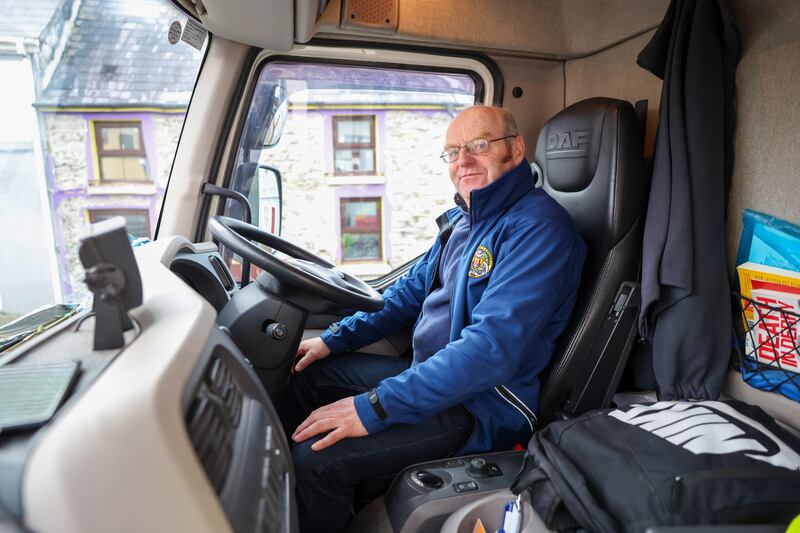

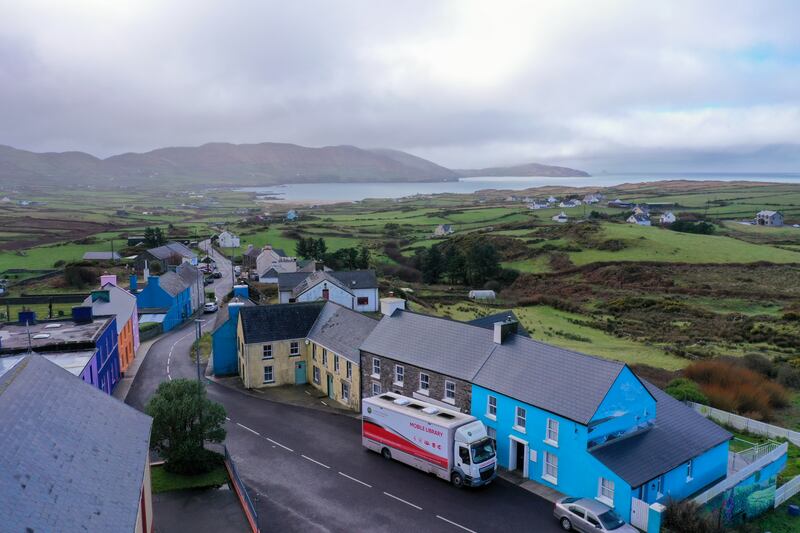
Driving with Crowley is to observe elements that refer to a former Ireland: things we once took for granted, but which have become less common over time. He unselfconsciously blesses himself every time we pass a church or a graveyard. He tells me about his two aunts, who both emigrated to New Orleans before they were 20. They both became nuns. “We’d be on our best behaviour when they came home, when I was a boy,” he says. One aunt is now dead. The other aunt is 92 and still living in the US. “We talk on the phone every couple of weeks,” he says, as we drive through the landscape of West Cork, from where so many others emigrated decades ago and never came back.
He knows these roads and who to look out for. “We use to stop at that house,” he says, as we drive past a bungalow near Allihies. “That woman is in a nursing home now.”
“Where we hope she is still reading,” I say.
“We do,” says Crowley.
“Dogs coming up,” he says then, as we approach another rural house. “There are two sheepdogs there who chase the van every time.”
Right on cue, as the mobile library passes, two energetic sheepdogs emerge from the driveway on the left and, barking loudly, tails wagging, run alongside us until the invisible thread of home pulls them back, and they retreat.
Some years back, there was a fear that the use of tablets in school would discourage children from reading actual books, but they still do read
— Zillah Ní Loideoin
The pair of Crowley and Ní Loideoin are clearly a strong team. They are greeted warmly everywhere they stop. They know everyone’s names.
“Seán is great for the sports chat with the teachers,” Ní Loideoin says to me at one point. “I know nothing about sports.”
Allihies is a village stop, where anyone can come along and choose their books. It’s also the lunch stop for the day. The doors of the bus remain open while parked on the main, only, street that runs through the picturesque village, where houses are painted in bright contrasting colours.
Not one person comes to the mobile library during its Allihies stop. Ní Loideoin says it is often “quiet”.
At Urhan National School, the van parks beside a patch of grass where a smattering of purple crocuses are just coming up. Crowley gives two blasts of the horn. There are only 17 pupils here, in the entire school. They start running out. “Mind the flowers!” one small boy cries out, but the impetus to get on the bus is strong with these children. Some flowers were definitely damaged in the process.
Ger O’Shea (9), takes out Football School, by Alex Bellos. Sinead Ryan (9), takes out Roald Dahl’s Charlie and the Chocolate Factory. Again, the children move like quicksilver through the van, immediately pulling out particular books as if their fingers were magnetised to them.


Sheila Sheehan (11) has her two books ready to check out. They are The Last Bear, by Hannah Gold, and Ahmed Aziz’s Epic Year. “I went looking for this one,” she says, pointing to The Last Bear, “And I read the back of this one and thought it looked good,” she says of Epic Year. Then she’s gone.
Half an hour is scheduled for each school stop, and during that time, Ní Loideoin also reshelves returned books, to keep the stock fresh for the next stop. I ask how it is that the children are so fast at choosing their books.
“They know where everything is,” she explains. She’s tried out different ways in the past of shelving books – by series, by Junior or Senior fiction – and now its alphabetic within Junior and Senior fiction. “Because that’s the way it is in real libraries.” She means libraries that don’t have magical wheels, like this one does. “I’d show new pupils at the start of the year where everything is, and then they figure it out very quickly.”
I ask her whether she has noticed any trends over time in the kinds of books that children want to borrow.
“Some years back, there was a fear that the use of tablets in school would discourage children from reading actual books, but they still do read,” she says. “Graphic novels are very big now. What we would have called comics. They are very useful for kids with dyslexia, or who are not that keen on reading. The classics are still popular - Roald Dahl, Enid Blyton. Dog Man is big. The Bunny versus Monkey books. Biographies about soccer players; children’s versions of premier league players and Real Madrid. We can’t put those out on the shelves as they are so popular. We keep them behind the counter and there is a limit of one each, otherwise there would be nothing left for the next school.”
[ ‘Buy less, play more’: The Monaghan toy library where everything is freeOpens in new window ]
As we drive to Eyries, she explains how things work at other stops they make on other days, such as nursing homes. “With Covid, we stopped going in, and still, you don’t meet a lot of people in nursing homes. But some people come out and choose their own books. In some places, the staff are so encouraging of helping people to come out themselves. It’s another social element to their day. It’s easy for us to get the wheelchair lift out if needed.” Staff in the nursing homes liaise with the mobile library in advance.
In other cases, Ní Loideoin personally chooses books for residents, bundling them up with their names on them. Large-print books, audio books on CDs, romance, Irish interest and photography-heavy books are all popular. Any feedback from readers is incorporated into the next lot of books to be borrowed. At daycare centres, where day residents rarely come out, she brings them in a mixed bag of books.
At Eyeries National School, there are 62 pupils. While the first group rush the bus, both principal Michael Lane and deputy Fergus Carey mull on why it is that interest in reading drops off sharply in boys aged 10-12. They point out that this is a national trend.
“They’re very busy,” says Lane.
“They have after-school activities,” says Carey.
But so do girls, I say.
“I don’t know the answer,” Lane admits.
For today anyway, both boys and girls at Eyeries National School are mad keen to get their hands on new books from the mobile library.
Ardgroom is the last stop of the day; another village stop. Five out of 10 members of a local book club show up together: Marian Lynch, Kathleen Lynch (no relation), Sue Floy, and husband and wife Charmain and Paul Arbuckle.


“We started it about 20 years ago, and meet on the last Thursday of the month,” Floy says. Like the primary schools requesting multiple copies of a book for a class to read, the book club can request copies of their featured book, as long as they give Ní Loideoin enough notice, usually two months.
Between them, these book club members each read on average 50 to 60 books a year, including those monthly book club reads. A percentage of these come from the mobile library. Two of their recent book club picks have been Finding My Way by Malala Yousafzai, and Raising Hare, by Chloe Dalton.
All the book club members praise Ní Loideoin’s willingness to help them out with any difficulties involving the library audio app, BorrowBox, or pre-ordering books for them. “Zillah is absolutely magic,” Marian Lynch states, before choosing an illustrated art book, Contemporary Landscapes.
Then it’s back in the bus for the return journey to Dunmanway, a trip of about 90km. It’s finally stopped raining. At one point, I ask Crowley, who knows these roads intimately of old, whether he still enjoys the scenery. “Ah, yes,” he says immediately, gesturing an arm beyond the window to the sodden horizon, where pale light is beginning to pulse from behind the clouds. “Even on a day like this.”


